
A UK company pays Corporation Tax on its worldwide profits, so income it earns abroad — royalties, interest, the profits of an overseas branch — is often taxed twice: once where it arises and again in the UK. Double taxation relief gives the company a credit for the foreign tax against the UK Corporation Tax on the same income. This guide shows how to claim it on the Double Taxation Relief tab and where it lands on the CT600.
How the credit works
Credit relief (TIOPA 2010 s18) is worked out source by source. For each item of overseas income the credit is the lower of:
- the foreign tax paid on it, limited to the rate the double tax treaty allows — anything withheld above the treaty rate should be reclaimed from the overseas tax authority, not the UK; and
- the UK Corporation Tax on that income (s42). The credit can wipe out the UK tax on a source, but never turn into a repayment or reduce the tax on the company’s other profits.
The total credit goes in CT600 box 450 and comes off the Corporation Tax chargeable in box 440.
Some overseas income needs no relief at all. Most dividends from overseas companies are exempt for a UK company, so there is no UK tax to credit against. A company that has elected for the foreign branch exemption leaves its branch profits out of UK tax altogether. And a disposal abroad is a chargeable gain — see Chargeable gains on the CT600.
Step 1: make sure the income is in the computation
The Double Taxation Relief tab only works out the credit. The overseas income itself must already be in the company’s profits, gross — before the foreign tax was deducted:
- overseas branch profits and trading royalties are part of the trading profit, so they come through the trial balance and the P & L section;
- overseas bank or loan interest belongs on Non Trade Credit (box 170);
- anything else that is not trading income goes on Non Trade Income (box 205).
If the bookkeeping recorded only the net amount received, gross it up in the accounts first. Otherwise the income is undertaxed and the credit is overstated.
Step 2: add a row for each source
Open Corp Tax Calculations and choose Double Taxation Relief from the Sections menu. Click Add Source for each item of overseas income taxed abroad, and enter:
- Source and Country — a description for the computation;
- Income — the gross amount included in this period’s taxable profits;
- Foreign tax — the tax paid on it, up to the treaty rate.
The Credit column is calculated for you, and the tab shows the average UK rate, the foreign tax and the total relief for the return.
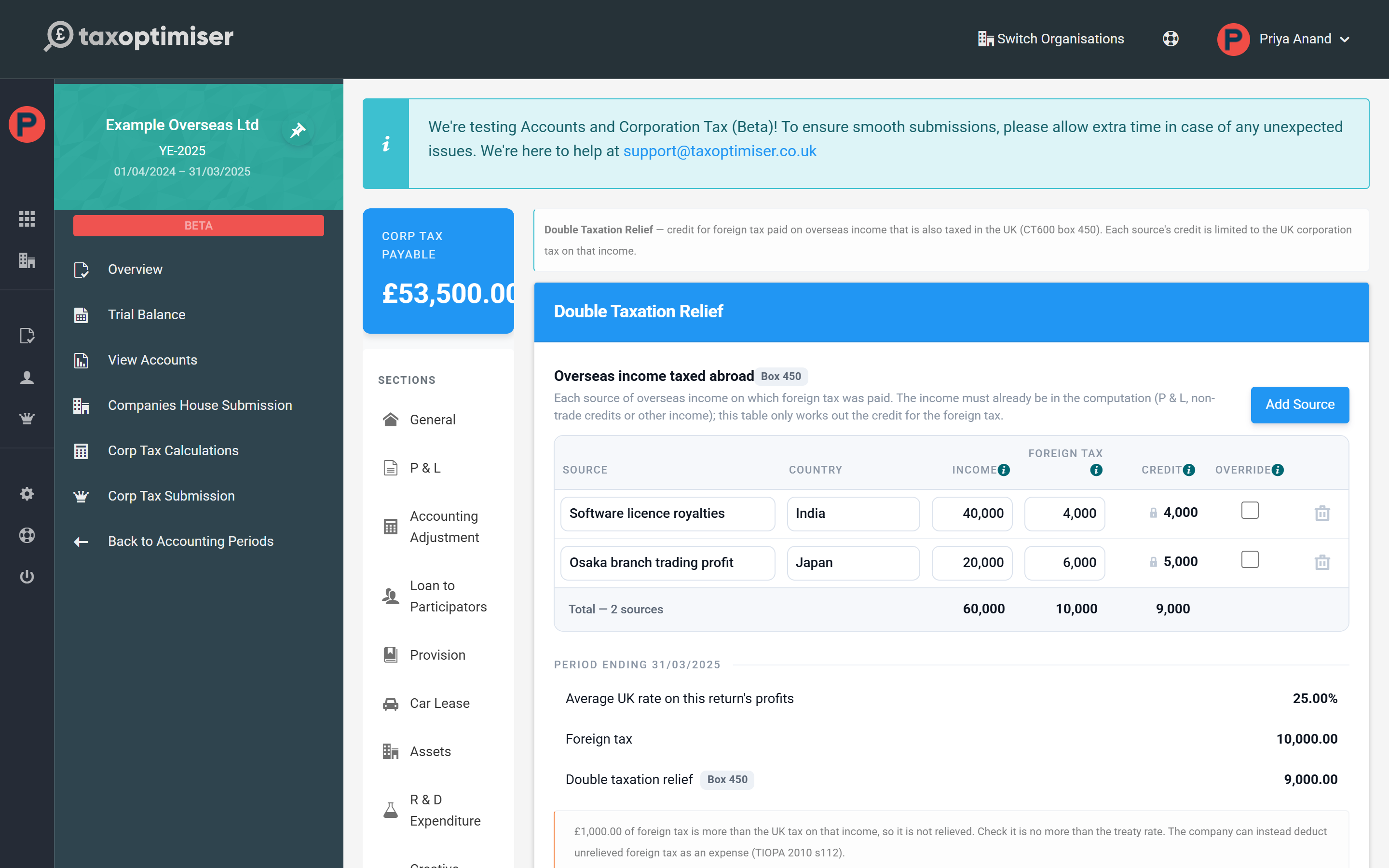
In the example, Example Overseas Ltd has trading profits of £250,000, including two items taxed abroad:
- software licence royalties from India of £40,000, with £4,000 withheld (the 10% treaty rate);
- the profit of its branch in Osaka, £20,000, on which £6,000 of Japanese tax was paid.
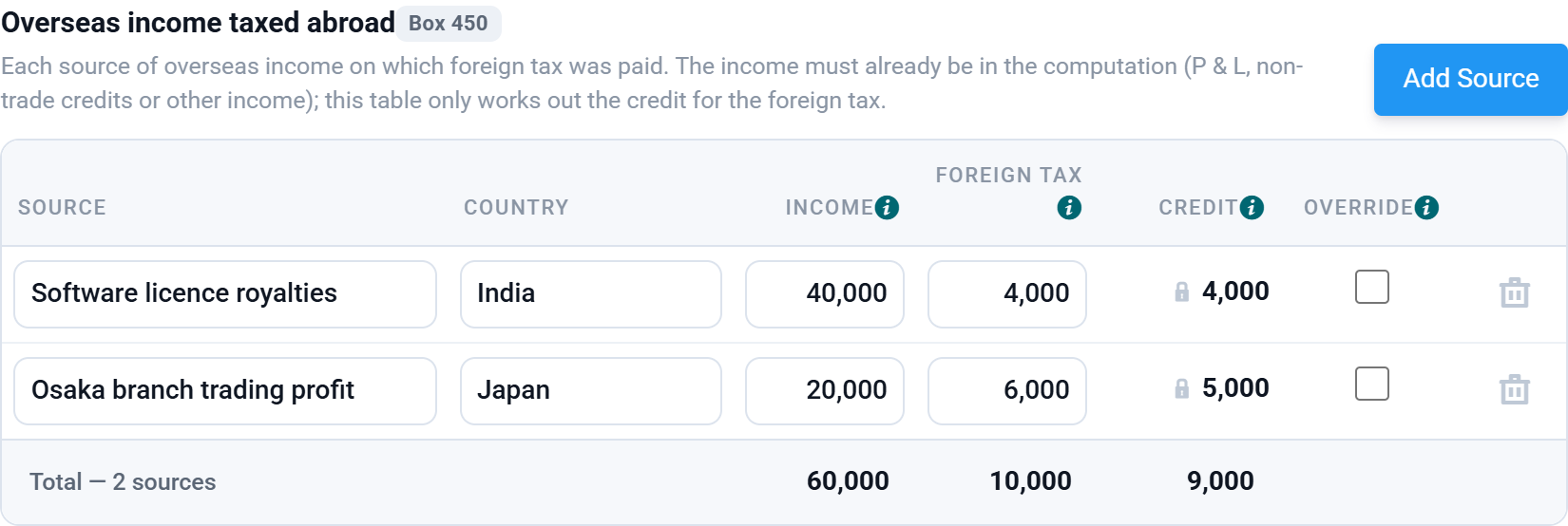
How the UK tax on each source is measured
Tax Optimiser measures the UK tax on each source at the return’s average rate: the Corporation Tax chargeable (after any marginal relief) divided by the profits chargeable. Example Overseas Ltd pays £62,500 on £250,000, exactly 25%, so:
- royalties: UK tax £40,000 × 25% = £10,000. The foreign tax of £4,000 is lower, so the credit is £4,000;
- branch: UK tax £20,000 × 25% = £5,000. The Japanese tax of £6,000 is higher, so the credit is capped at £5,000.
For a company paying marginal relief the average rate falls below 25%. A company with £100,000 of profits pays £22,750, an average of 22.75%, so £20,000 of royalties with £5,000 of foreign tax gets a credit of £4,550.
The law lets a company decide how its deductions are set against its different sources (s52), which can give a source a higher share of the UK tax. If you have worked the credit out that way, tick Override on the row and type the credit into the Credit cell. The override is still capped at the foreign tax, and the total at the Corporation Tax chargeable.
The average rate is fixed each time the computation is saved and recalculated, so save after changing the rest of the computation to refresh the credits.
Unrelieved foreign tax
Where the foreign tax is more than the UK tax on the income, the difference is not relieved. In the example £1,000 of the Japanese tax is left over, and the tab and the Considerations list both flag it.
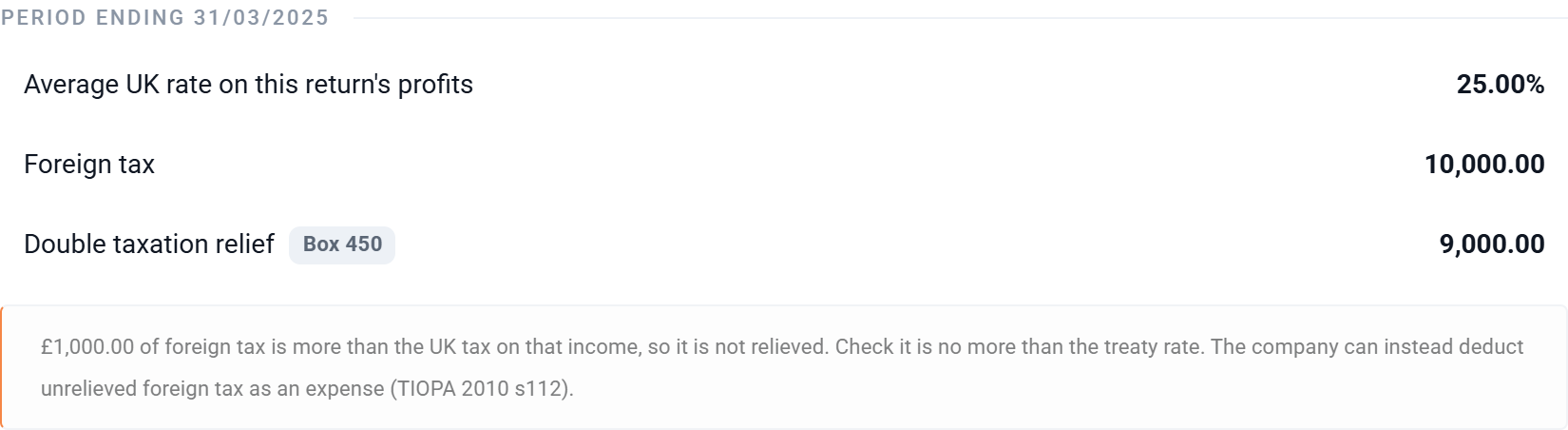
Check first that the foreign tax is no more than the treaty rate. Beyond that, a company can choose to deduct foreign tax as an expense instead of claiming credit for it (s112). That is rarely better, and Tax Optimiser does not do it automatically: leave the source off this tab and deduct the tax in the computation instead. Surplus foreign tax on the profits of an overseas branch can, in some cases, be carried back or forward against the same branch’s profits; that claim is not made here.
Where the relief shows up
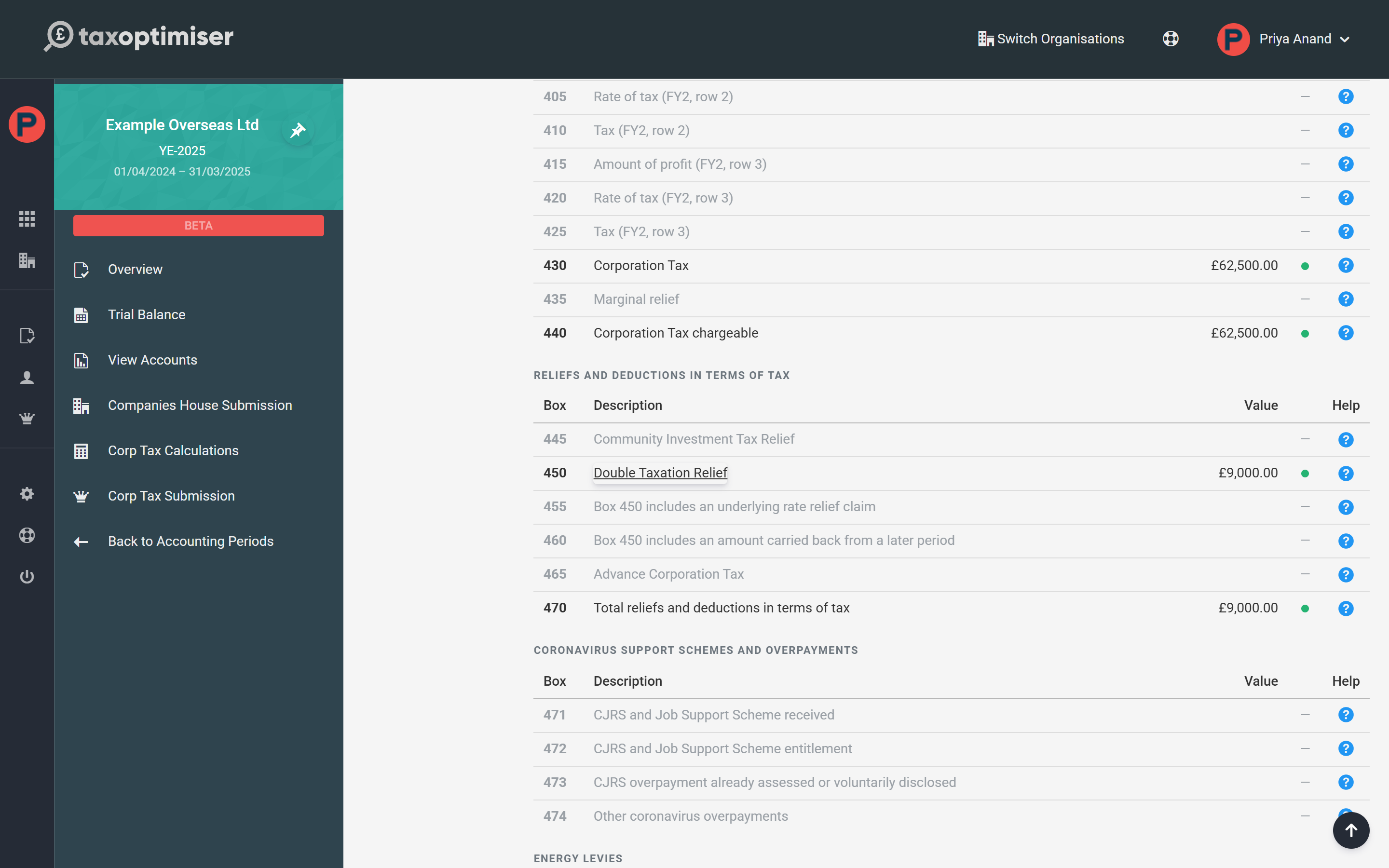
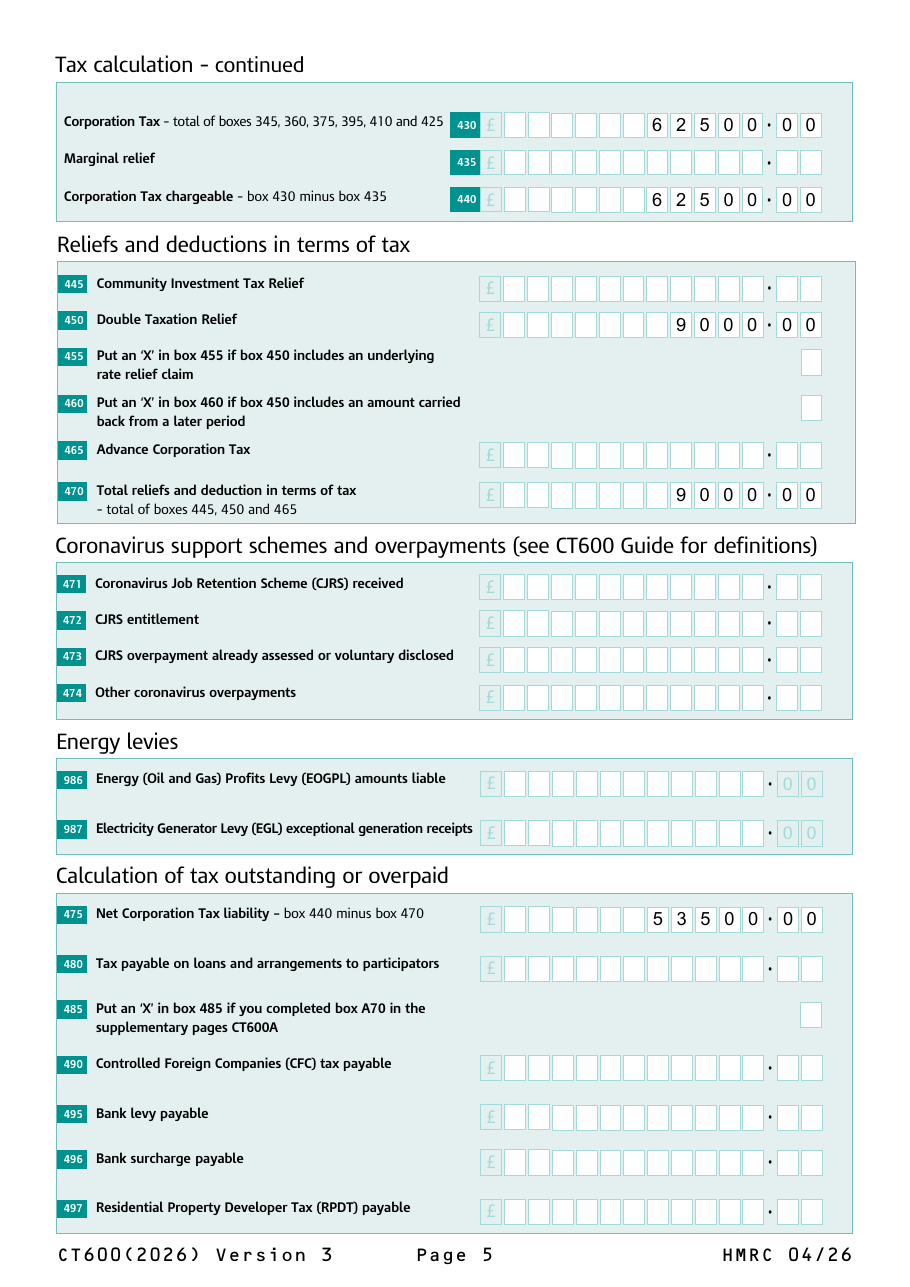
The Corp Tax Payable headline updates straight away: £62,500 less £9,000 = £53,500. The computation lists each source and its credit under the Corporation Tax calculation.
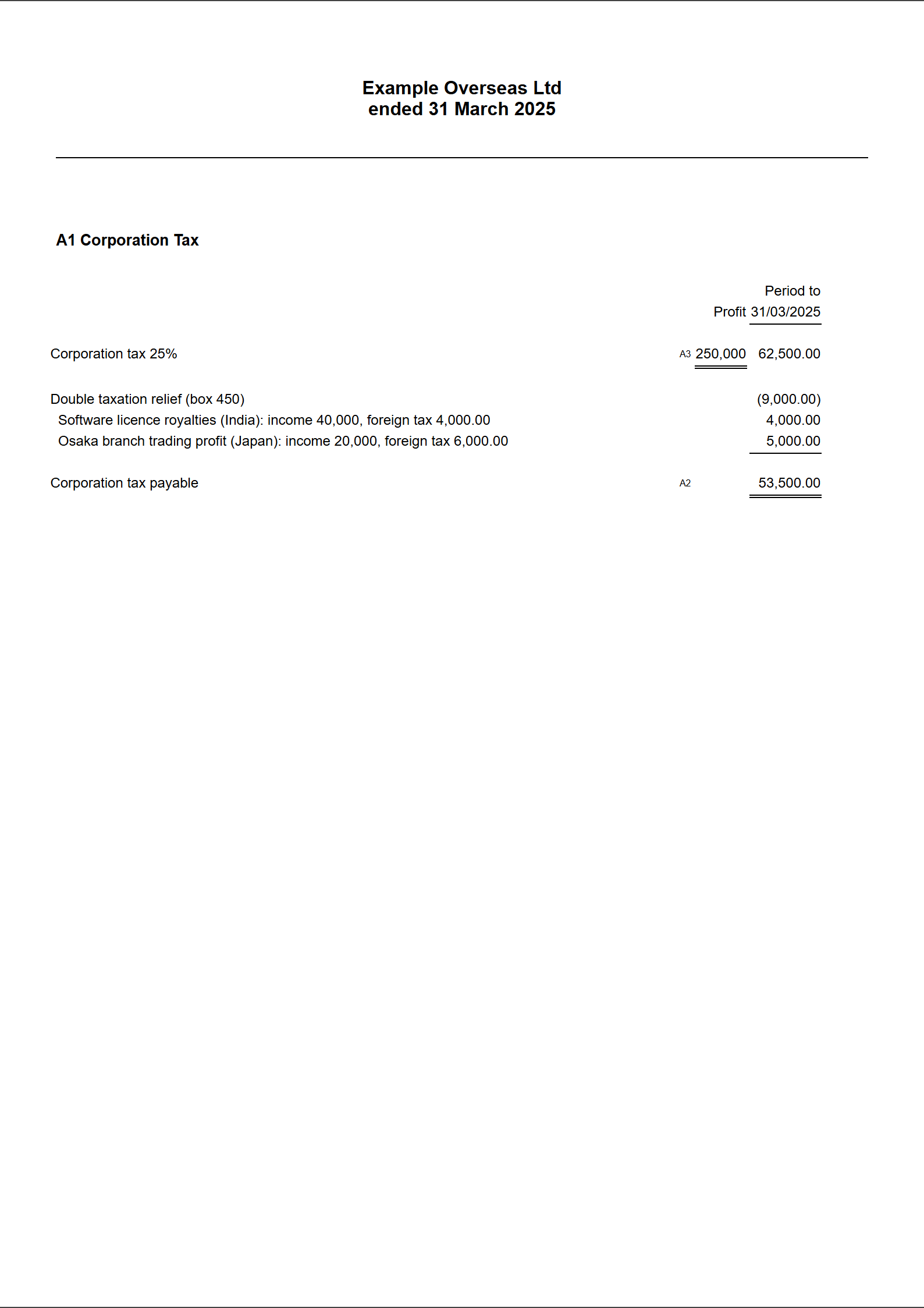
The CT600 Boxes section shows boxes 450 and 470, and the CT600 carries them on page 5.
Long periods of account
When the accounts run for more than twelve months the return is split into two periods, and the tab shows Income, Foreign tax and Credit columns for each. Enter the income and foreign tax in the return period whose profits include the income. Each return has its own average rate and its own box 450.
CT600 boxes
Box 450 — Double Taxation Relief
The total credit for foreign tax: the sum of the credits on the Double Taxation Relief tab, never more than box 440 less box 445. It is reported in pounds and pence.
Box 455 — Underlying rate relief claim
Ticked when box 450 includes relief for the foreign tax paid by an overseas company on the profits behind a dividend. Most foreign dividends are exempt for UK companies, so this is rarely needed; Tax Optimiser does not claim it and leaves the box blank.
Box 460 — Amount carried back from a later period
Ticked when box 450 includes surplus foreign tax on branch profits carried back from a later period. Tax Optimiser does not make this claim and leaves the box blank.
Box 470 — Total reliefs and deductions in terms of tax
Box 445 plus box 450 plus box 465. With only double taxation relief it equals box 450.
Box 475 — Net Corporation Tax liability
Box 440 less box 470: the Corporation Tax after double taxation relief. R&D and creative industries credits are set off after this.
Frequently asked questions
What is double taxation relief for a company?
A credit against UK Corporation Tax for foreign tax the company paid on the same overseas income, so it is not taxed twice. It is claimed in box 450 of the CT600.
How much credit can a company get?
For each source, the lower of the foreign tax (up to the treaty rate) and the UK Corporation Tax on that income. The credit cannot create a repayment or reduce the tax on other profits.
Do I enter the overseas income net or gross?
Gross. The income must be in the computation before the foreign tax was deducted, and the Income column on the Double Taxation Relief tab is that gross amount.
What happens to foreign tax that is more than the UK tax?
It is not relieved. Check it is no more than the treaty rate and reclaim any excess abroad. A company can instead deduct foreign tax as an expense, but that is rarely better.
Why is the UK tax measured at an average rate?
The average rate spreads marginal relief across all the company’s profits. If you allocate deductions to sources differently, tick Override and enter the credit you have worked out.
Do I need double taxation relief for foreign dividends?
Usually not. Most dividends a UK company receives from overseas companies are exempt from Corporation Tax, so there is no UK tax to set a credit against.
Where to go next
- Building the Corporation Tax computation — the other sections of Corp Tax Calculations.
- CT600 box-by-box guide — every box on the main return.
- HMRC’s Double Taxation Relief Manual — the detailed rules, including treaty rates and the allocation of deductions.