
If a director or shareholder takes money out of their company and it is not salary, a dividend or a repayment of something they lent the company, it is a loan — and the company may have to pay tax on it. That tax is the section 455 charge (everyone calls it “S455”), and it is declared on CT600A, a supplementary page of the Company Tax Return. This guide explains when you need a CT600A, what the charge costs and when you get it back, how to enter loans in Tax Optimiser, and what every box on the form means.
When a company needs a CT600A
Three things have to be true at once:
- The company is a close company. Broadly, it is controlled by five or fewer participators, or by its directors. Nearly every owner-managed UK company is close.
- A participator (or their associate) owed the company money. A participator is someone with a share or interest in the company’s capital or income — usually a shareholder, and in practice usually a director-shareholder. An associate is a close relative, a business partner, or a trust or partnership connected with them: a loan to a director’s spouse or adult child counts just as much as a loan to the director.
- It was a loan, an advance or an arrangement conferring a benefit — not pay and not a dividend. The classic case is an overdrawn director’s loan account: drawings taken through the year that were never voted as salary or dividend.
If all three apply, the CT600A goes in with the return and box 95 on the CT600 is ticked. Tax Optimiser handles this for you: enter the loans and the supplementary page is attached, the box is ticked, and the tax lands in box 480 of the main return. It attaches the page whenever there is a charge to declare, a balance still outstanding at the period end, or a relief claim to make — and leaves it off when there is nothing to report, because HMRC rejects a return whose box 95 and CT600A disagree.
A few things are not participator loans: money the director lent to the company (that is a credit balance — no S455), a loan to an employee who is not a participator or an associate of one, and normal trade credit given to a customer who happens to be a shareholder.
The section 455 charge in plain English
The charge is 33.75% of the loan still outstanding at the end of the accounting period. That is the same rate as the upper dividend rate — deliberately, because the rules exist to stop a shareholder taking a tax-free “loan” instead of a taxable dividend. Loans made before 6 April 2022 are charged at the old 32.5%; Tax Optimiser picks the rate from the loan’s date, so a period that straddles the change is charged correctly.
Four things people are usually surprised by:
- It is due at the normal Corporation Tax due date — nine months and one day after the end of the accounting period — even though it is not really Corporation Tax on profits.
- It is temporary. S455 is refunded once the loan is repaid, released or written off. It is a deposit with HMRC, not a permanent cost.
- Repay within nine months and there is nothing to pay at all. If the loan is cleared by the due date, the charge is cancelled by the matching relief — but the loan must still be declared on the CT600A. Silently leaving it off is a wrong return.
- The refund is slow. Repay later and the refund is not due until nine months and one day after the end of the accounting period in which the repayment was made — which can be nearly two years after the money goes back.
Two other taxes ride alongside the S455 charge, and Tax Optimiser does not calculate either — check them separately:
- A benefit in kind if the loan exceeds £10,000 at any point in the tax year and is interest-free or cheap: report it on a P11D and pay Class 1A National Insurance.
- Income tax on the individual if the loan is written off or released: the amount is taxed on the participator broadly as a dividend, and National Insurance can apply too.
Repaying and re-borrowing does not work. Anti-avoidance rules (“bed and breakfasting”) deny relief where £5,000 or more is repaid and a similar amount is drawn again within 30 days, or where there were arrangements to re-borrow. Tax Optimiser takes the figures you enter at face value — it cannot see the 30-day pattern, so satisfy yourself that a repayment is genuine before claiming relief on it.
Enter the loans in Tax Optimiser
Open the accounting period’s Corp Tax workspace and choose Loan to Participators in the left-hand menu. Every loan is one row, so one director with one overdrawn account is one row — do not merge two people into a single line, because HMRC wants each participator named.
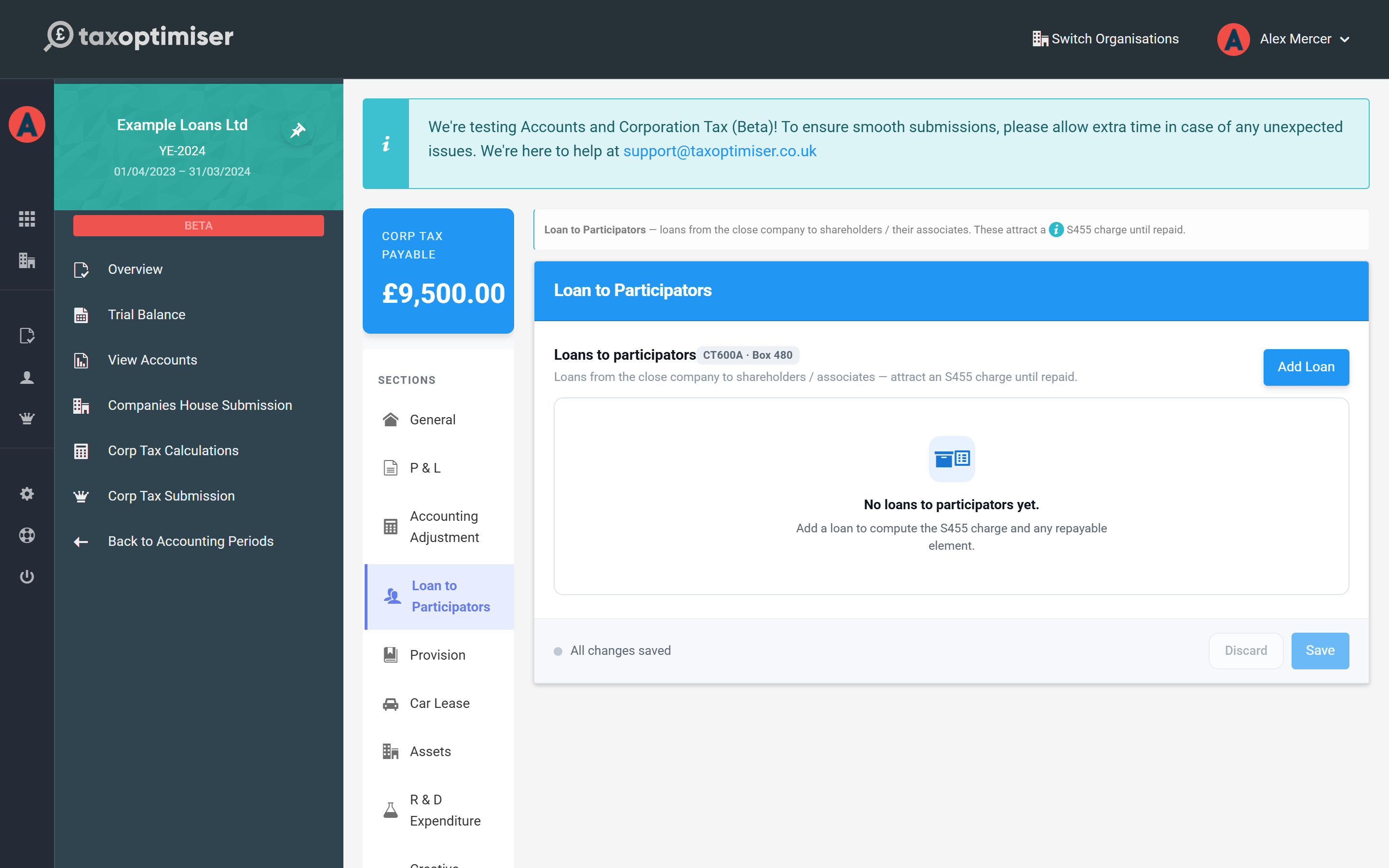
Choose Add Loan and fill in the row. The small grey chips in the column headings (A10B, A25D, A20…) tell you which CT600A box that column feeds, and hovering a heading explains the rule in a sentence.
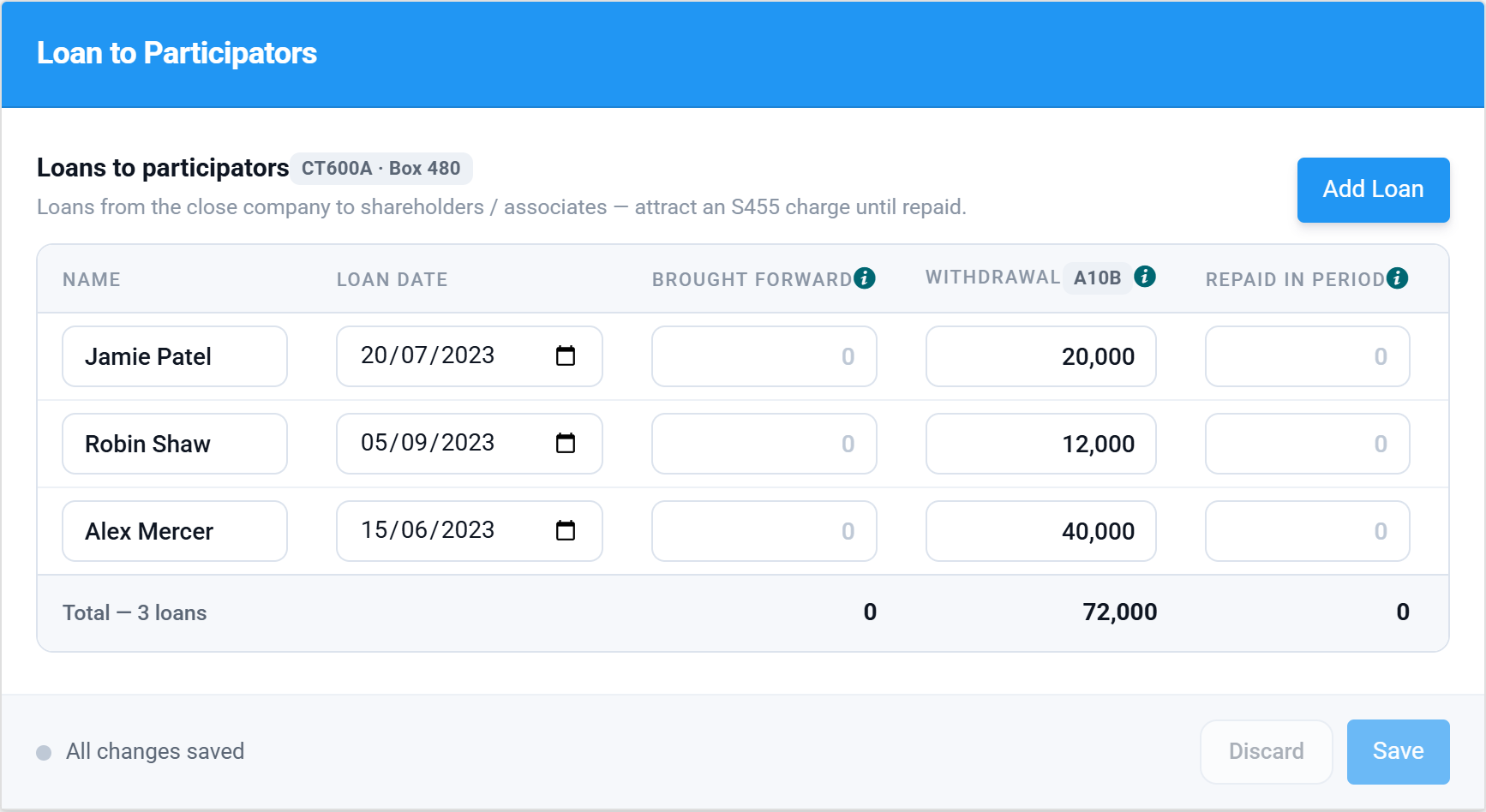
The columns you type into:
| Column | What goes in it | Box |
|---|---|---|
| Name | The participator or associate, as HMRC should see it. Two to 56 characters, no £, $, #, ~ or € symbols. | A10A |
| Loan date | When the loan was made. It sets the rate (32.5% before 6 April 2022, 33.75% after) and must fall inside the period. | — |
| Brought forward | The balance owed at the start of the period. This is not charged again — it was charged in the period it arose. | — |
| Withdrawal | New money advanced during the period. This is what S455 bites on. | A10B |
| Repaid in period | Amounts the participator paid back before the year end. These reduce the balance outstanding, so they reduce the charge. | — |
| Repaid within 9m of year end | Amounts repaid, released or written off after the year end but within nine months and one day of it — including a loan cleared by voting a dividend or bonus to the account. | A25B / A25C |
| Repaid within 9m date | The date that happened. Required — without it the relief cannot be claimed and the return will not file. | A25D |
| Repaid after 9m | Amounts cleared more than nine months after the year end but before this return is filed. | A50B / A50C |
| Repayment date | The date of that later repayment. | A50D |
| Released | Tick if the later amount was released or written off rather than repaid — it is reported in a different column of the form. | A50C |
| Return pmt | Tick only for a return payment against the value of a benefit conferred. Return payments made on or after 30 October 2024 no longer get relief. | — |
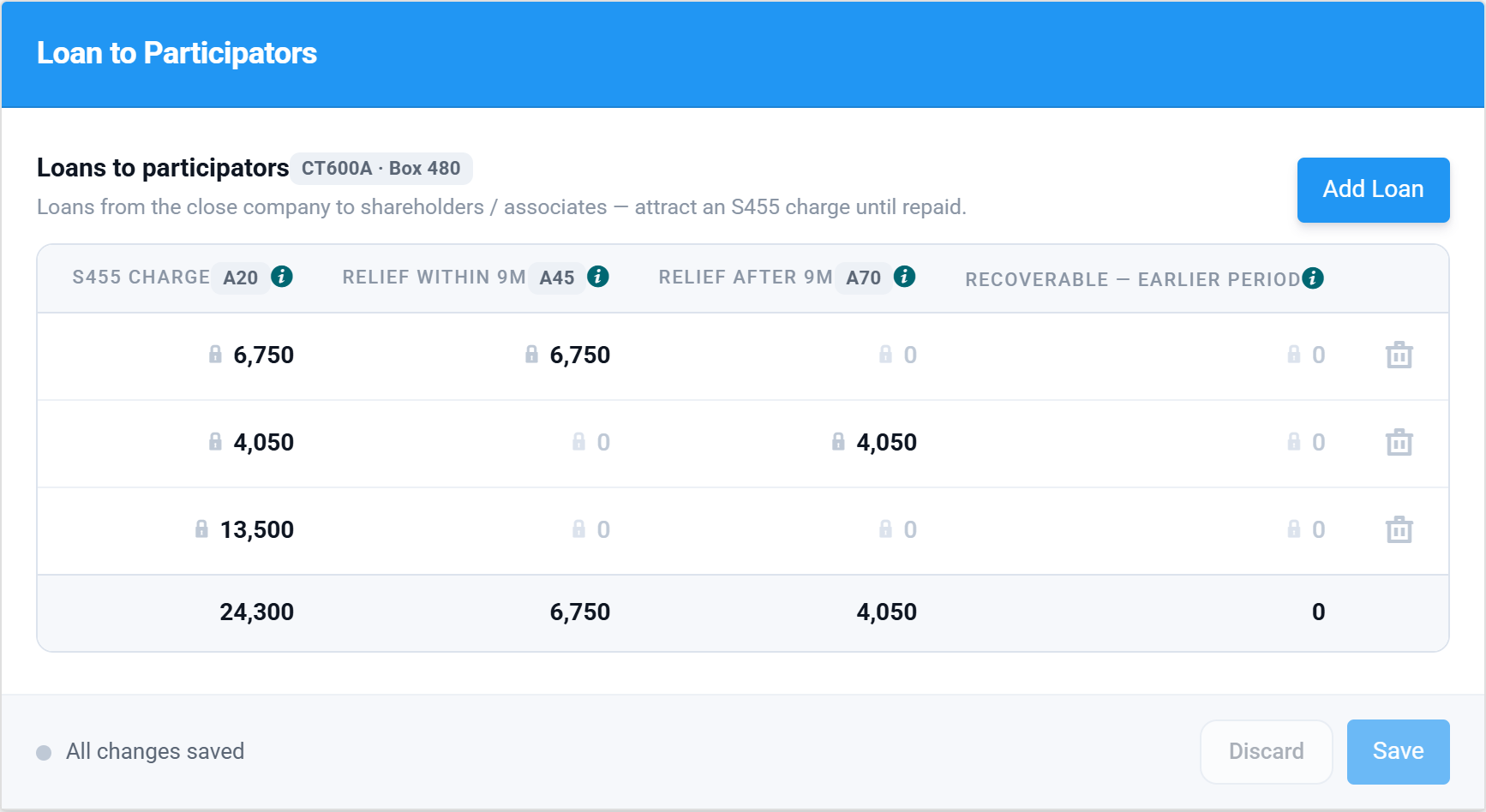
The remaining columns are calculated for you as soon as you Save:
- S455 charge (box A20) — the charge on this period’s advances, before any relief.
- Relief within 9m (box A45) and Relief after 9m (box A70) — the section 458 relief that cancels it.
- Recoverable — earlier period — S455 paid in an earlier period that this period’s repayment has made refundable. It cannot be claimed on this return; see which return the relief goes on below.
What the figures do to the return
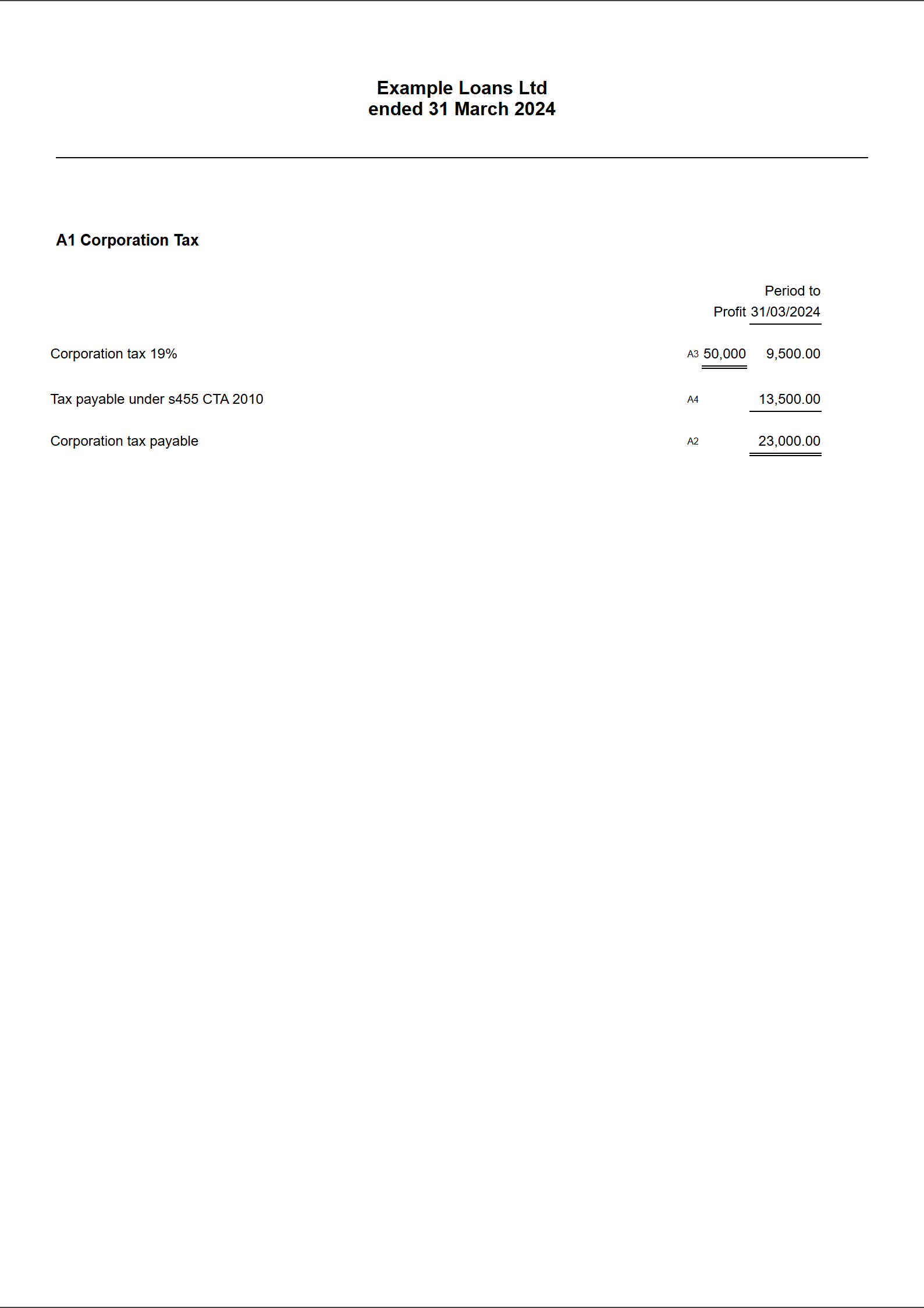
Save and recalculate, and the charge joins the Corporation Tax on profits in the computation’s tax summary — the two are due on the same day and paid together.
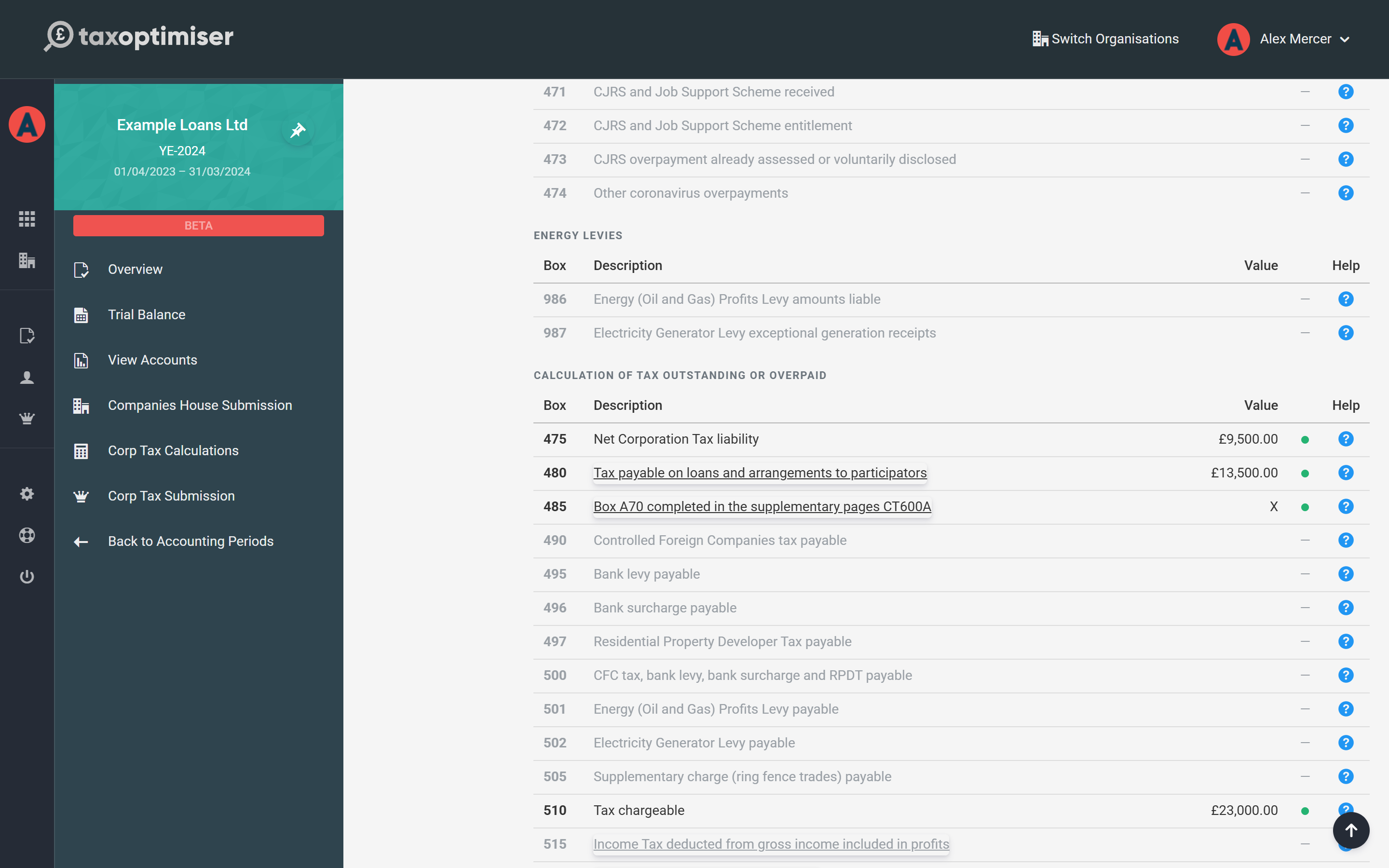
In the CT600 Boxes section you can see exactly where it lands: box 95 (CT600A attached), box 480 (tax payable on loans) and, if you are claiming later-repayment relief, box 485. Each box links through to the CT600 box-by-box guide.
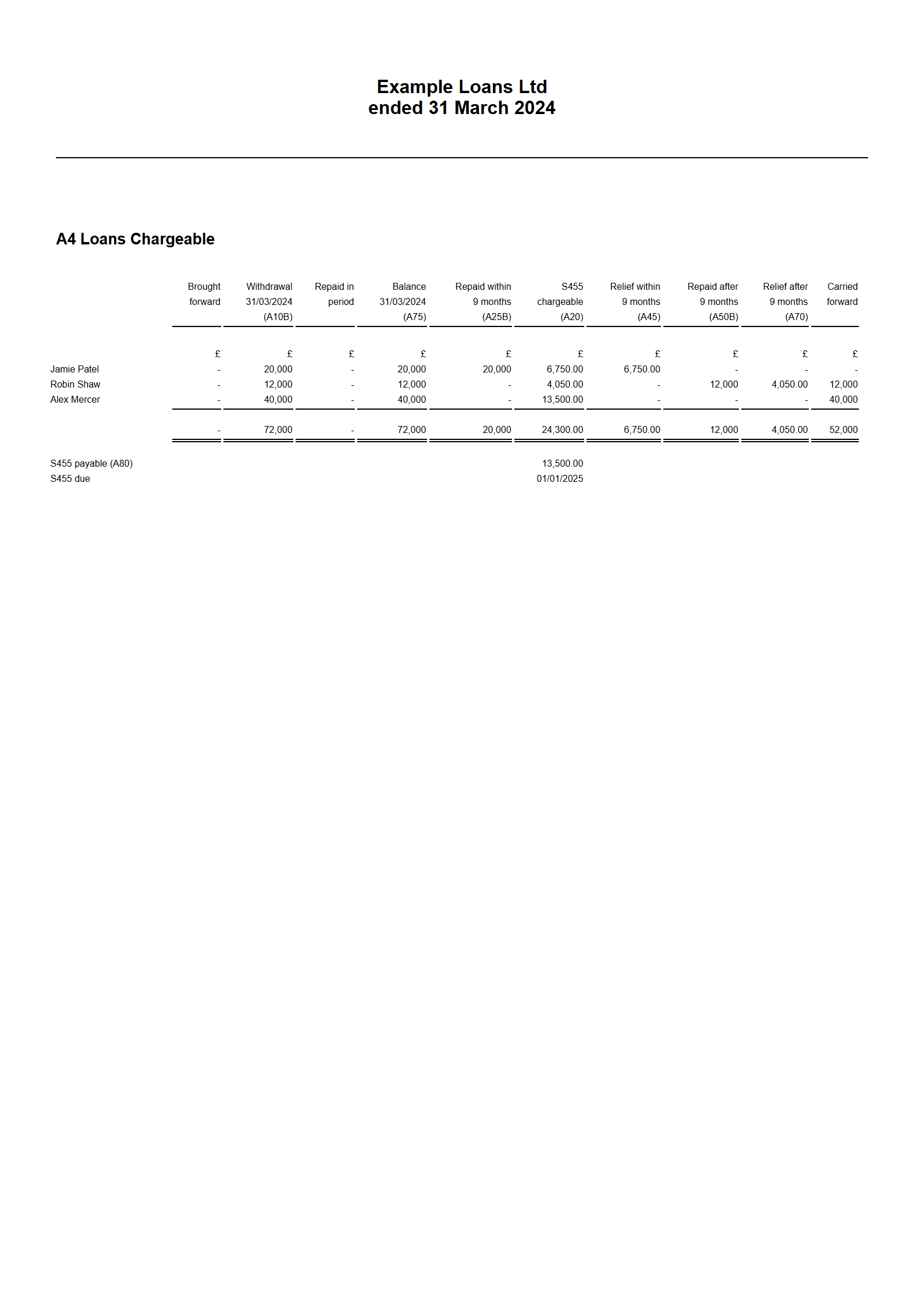
The computation prints its own Loans Chargeable page, showing every loan’s movement, charge and relief — this is the page to give a client or a reviewer.
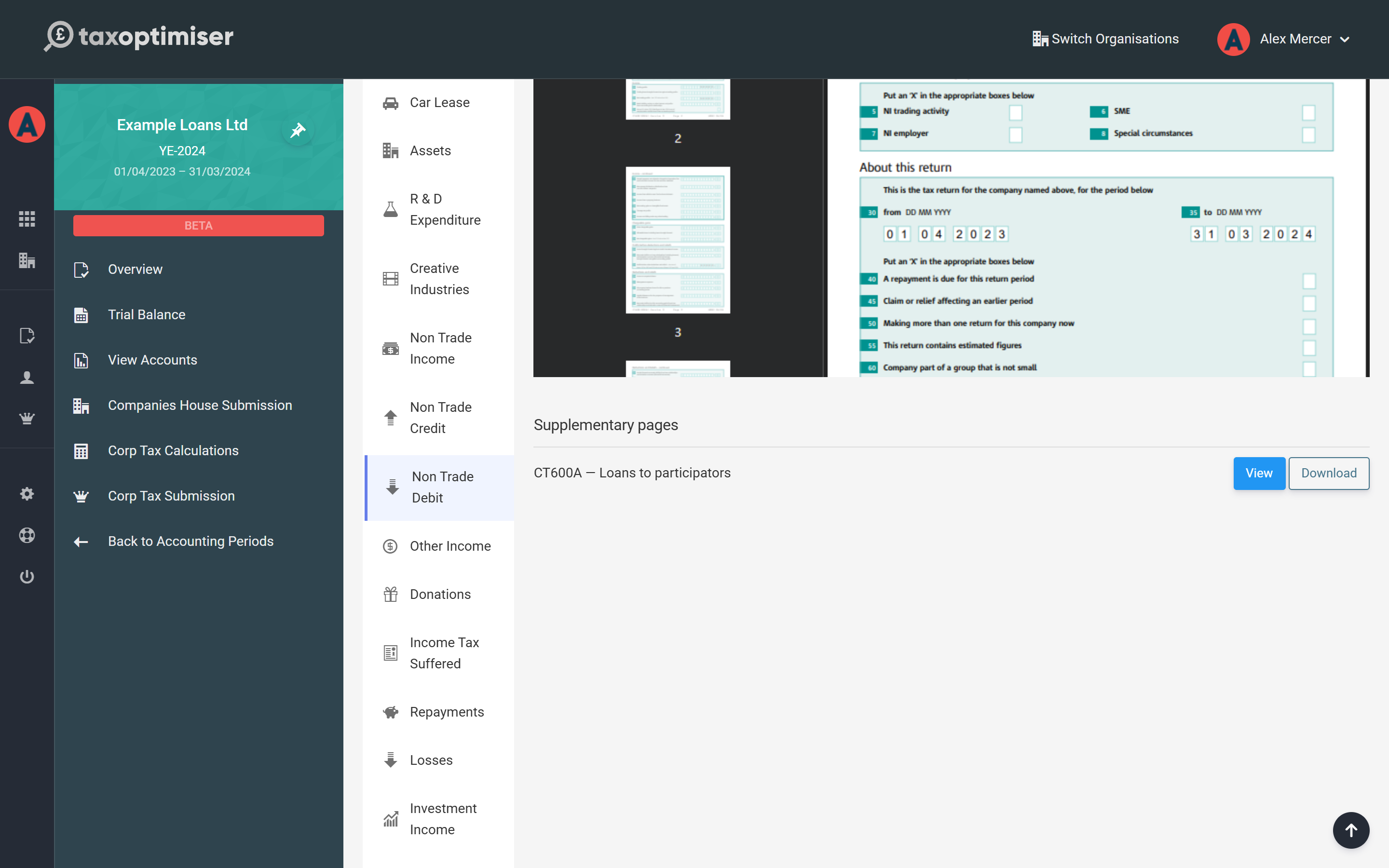
And the CT600A itself is generated with the return. Open it from the supplementary pages list to see the completed form before you file.
If you are an accountant with a firm login, Reports → Outstanding Directors Loan lists participator balances across all your clients — the quickest way to spot a loan that is about to cost 33.75% while there is still time to clear it.
A worked example
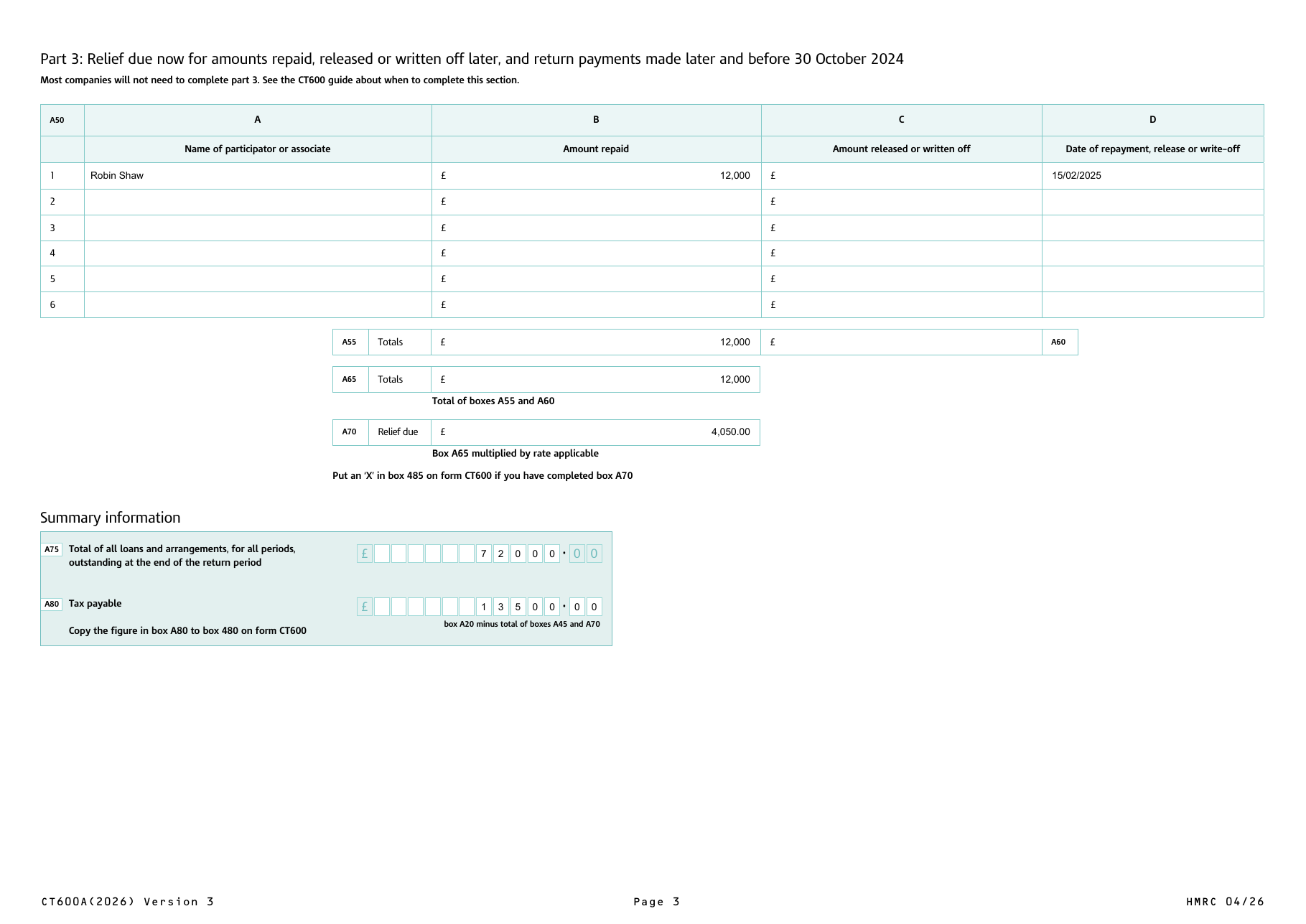
The screenshots come from a demonstration company, Example Loans Ltd, with a 31 March 2024 year end and three loans, each chosen to show one rule. The company is filing late, which is why Part 3 of the form comes into play at all — on a return filed by the normal deadline it would be empty:
| Participator | What happened | Charge at 33.75% | Relief |
|---|---|---|---|
| Alex Mercer | Drew £40,000, still outstanding | £13,500 | None — payable |
| Jamie Patel | Drew £20,000, repaid it on 30 September 2024 | £6,750 | Part 2 — £6,750 |
| Robin Shaw | Drew £12,000, repaid it on 15 February 2025 | £4,050 | Part 3 — £4,050 |
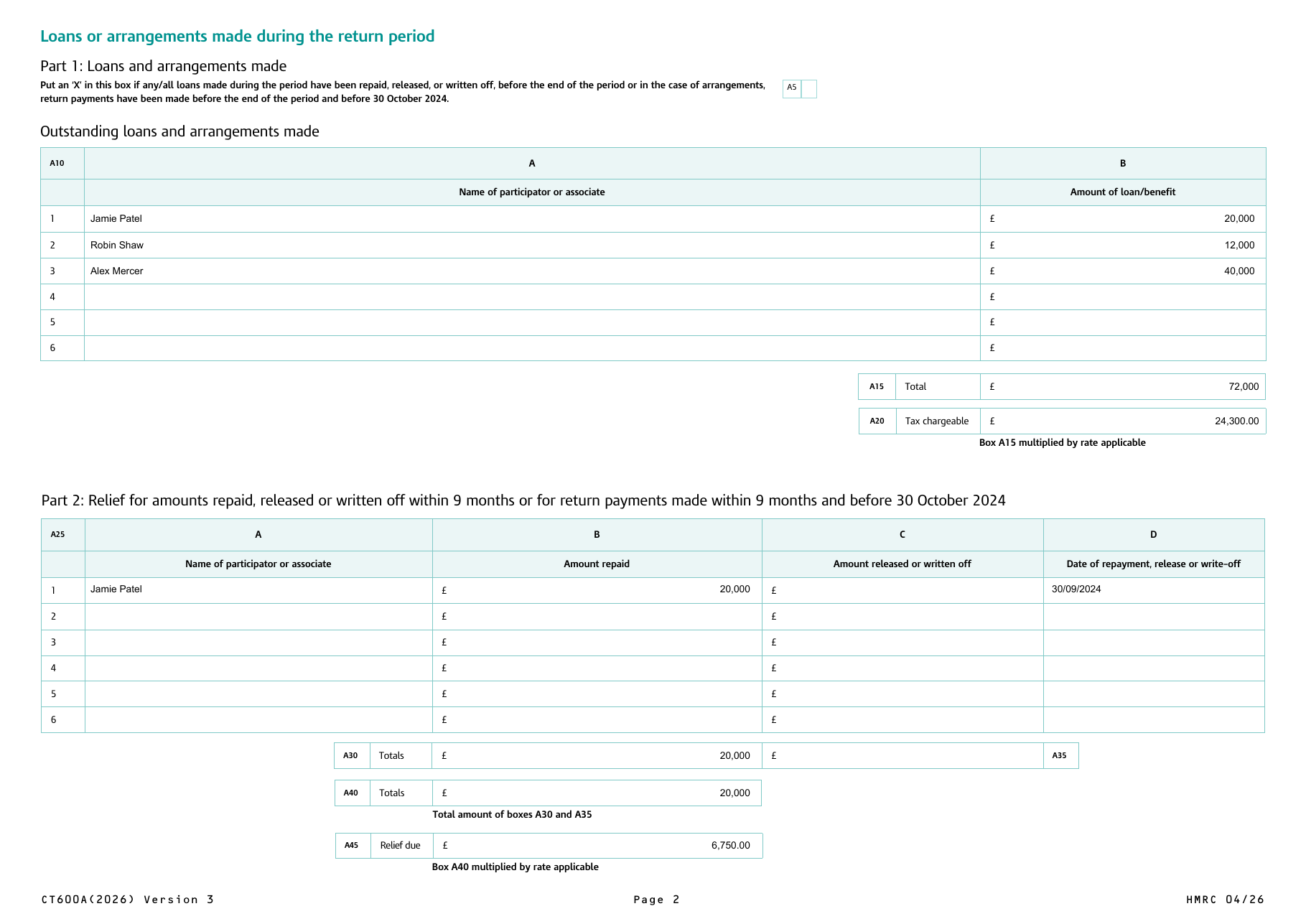
So box A15 is £72,000, box A20 is £24,300, and after relief of £6,750 in Part 2 and £4,050 in Part 3 the tax payable in box A80 — and therefore box 480 — is £13,500: exactly the charge on the one loan still outstanding. Notice that all three loans appear in Part 1, including the ones that were repaid. Part 1 reports what was outstanding at the year end; the repayments are relieved further down the form, not netted off at the top.
Which return does the relief go on
Section 458 relief is the mirror image of the S455 charge, and the only hard question is which return it belongs on. Work from the date the money went back:
- Repaid before the year end — nothing to relieve. The loan simply was not outstanding, so no charge arises. Use the Repaid in period column.
- Repaid within nine months and a day of the year end — relief on this return, in Part 2. The charge and the relief cancel out and nothing is paid.
- Repaid later, but relief has already fallen due — Part 3 of this return. Relief falls due nine months and one day after the end of the accounting period in which the repayment was made, so Part 3 is really for returns filed late. HMRC’s own note on the form says most companies will not need it.
- Repaid later and relief is not yet due — leave it off this return and claim it when it falls due, by amending the return for the period the loan was made or with form L2P.
- The repayment clears a loan from an earlier period — not this return either, whatever the dates. The S455 was charged on that earlier return, so the refund is claimed there. Tax Optimiser shows the amount in the Recoverable — earlier period column so you know to go and get it.
A claim on Part 3 also ticks box 485 on the main return, which is how HMRC knows to expect it.
What Tax Optimiser will not let you file
HMRC validates the CT600A hard, and a rejected submission costs a day. Tax Optimiser applies the same rules before you send, so these come up as errors on the return, not as an HMRC rejection:
- A missing within-nine-months date. Enter an amount in Repaid within 9m of year end and the date becomes mandatory — without it the relief drops out of the form and the full charge would fall due.
- A date outside its window. A within-nine-months date must fall after the year end and no more than nine months and a day after it; a later repayment date must be more than nine months after it. Amounts repaid during the period belong in Repaid in period.
- A date in the future. Relief can only be claimed for something that has already happened.
- Relief larger than the charge. Relief on the form cannot exceed box A20, because the form has no way to express it. Where a repayment is clearing a brought-forward loan, that excess belongs on the earlier period’s return or on form L2P.
- Return payments on or after 30 October 2024. These no longer qualify for section 458 relief, so ticking Return pmt with a later date removes the claim.
CT600A box by box
Box numbering follows the CT600A (2026) Version 3 form, used for accounting periods starting on or after 1 April 2015. Boxes on the main CT600 are covered in the CT600 box-by-box guide.
Box A1 — Company name
The registered company name, taken from the accounting period so it matches the return and the accounts.
Box A2 — Tax reference
The company’s 10-digit Unique Taxpayer Reference, the same one as on the CT600.
Boxes A3 and A4 — Period covered by this supplementary page
The start and end dates of the return period, which cannot exceed 12 months. A period of account longer than 12 months is filed as two returns, and each carries its own CT600A covering only that return period — Tax Optimiser splits the loans automatically, so the same charge is never declared twice.
Box A5 — Loans repaid before the end of the period
An “X” box, ticked when every loan made during the period was repaid, released or written off before the period ended (or, for arrangements, the return payments were made before the period end and before 30 October 2024). In Tax Optimiser those amounts go in the Repaid in period column, which removes them from the charge.
Box A10 — Outstanding loans and arrangements made
The heart of Part 1: one line per participator, column A for the name and column B for the amount.
- A10A — Name of participator or associate. From the Name column of the grid.
- A10B — Amount of loan/benefit. The advance made in the period and still outstanding at the period end, in whole pounds: withdrawals less anything repaid during the period itself. Repayments made after the year end do not reduce it — they are relieved in Part 2.
The printed form has six lines. With more than six participators the figures are still filed in full in the XML sent to HMRC; the PDF summarises the remainder on the last line.
Box A15 — Total
The sum of the A10B amounts — every pound of this period’s lending that was still outstanding at the year end.
Box A20 — Tax chargeable
Box A15 multiplied by the applicable rate: 33.75%, or 32.5% for loans made before 6 April 2022. Tax Optimiser charges each loan at the rate for its own loan date, so a period spanning the change still adds up.
Box A25 — Relief for amounts repaid, released or written off within 9 months
Part 2, one line per repayment, in four columns:
- A25A — name of the participator or associate.
- A25B — amount repaid.
- A25C — amount released or written off (use this column instead of A25B when the debt was waived rather than paid).
- A25D — the date of the repayment, release or write-off. It must be after the period end and within nine months and a day of it.
Box A30 — Total amount repaid
The total of column A25B, in whole pounds.
Box A35 — Total amount released or written off
The total of column A25C.
Box A40 — Totals
Boxes A30 and A35 added together: the principal being relieved.
Box A45 — Relief due
Box A40 multiplied by the applicable rate — the section 458 relief that cancels the charge on a loan cleared within nine months. It can never exceed box A20; relief beyond that is clearing an earlier period’s loan and is claimed on that period’s return or with form L2P.
Box A50 — Relief due now for amounts repaid, released or written off later
Part 3, with the same four columns as Part 2 — A50A name, A50B amount repaid, A50C amount released or written off, A50D date — but for repayments made more than nine months after the period end. As the form itself says, most companies will not need Part 3: it only applies where the return is being filed late enough that the relief has already fallen due.
Box A55 — Total amount repaid
The total of column A50B.
Box A60 — Total amount released or written off
The total of column A50C.
Box A65 — Totals
Boxes A55 and A60 added together.
Box A70 — Relief due
Box A65 multiplied by the applicable rate. Completing it means box 485 on the CT600 must be ticked, which Tax Optimiser does for you.
Box A75 — Total of all loans and arrangements outstanding at the end of the return period
A whole-pound figure covering all periods, not just this one: the total participator balance owed at the year end, brought-forward amounts included. It is the balance-sheet number, so repayments made after the year end do not reduce it — a loan repaid in month ten still shows here, with the relief claimed further up the form.
Box A80 — Tax payable
Box A20 minus boxes A45 and A70, never below zero. This is the figure copied to box 480 on the CT600 and paid with the Corporation Tax.
Main return: boxes 95, 480 and 485
Three boxes on the CT600 itself are driven by the CT600A: box 95 (the CT600A is attached), box 480 (tax payable on loans to participators, equal to A80) and box 485 (box A70 has been completed). Tax Optimiser sets all three from the loans you enter — a mismatch between box 95 and the attached page is one of HMRC’s most common rejections.
Common questions
What is the S455 tax rate on a director’s loan?
33.75% of the loan outstanding at the company’s year end, for loans made on or after 6 April 2022. Loans made before that date are charged at 32.5%. The rate matches the upper rate of dividend tax, because the charge exists to stop a shareholder taking a loan instead of a dividend.
Do I pay S455 if the loan is repaid before the year end?
No. The charge only applies to amounts still outstanding at the end of the accounting period, so a loan repaid during the year attracts no charge. Enter the repayment in the Repaid in period column.
What happens if I repay a director’s loan within nine months?
The charge is cancelled by section 458 relief, so nothing is payable — but the loan and the repayment must still be declared on the CT600A, in Part 1 and Part 2 respectively. You must enter the date of the repayment; without it the relief cannot be claimed and the return will not file.
When is the S455 charge due?
Nine months and one day after the end of the accounting period, the same date as the Corporation Tax on the company’s profits. It is paid with the rest of the return’s tax and shows in box 480.
How do I get S455 tax back?
The tax is repaid when the loan is repaid, released or written off, but the refund is not due until nine months and one day after the end of the accounting period in which the repayment happened. If the return for the period that carried the charge is still open you can amend it; otherwise claim with form L2P.
Does a loan to a director’s spouse count?
Yes. The rules cover loans to a participator or to an associate of one, and associates include close relatives such as a spouse, parent or child, as well as business partners and connected trusts.
Is the CT600A needed if the loan is under £10,000?
Yes. There is no small-loan exemption from the section 455 charge — any participator loan outstanding at the year end is reportable. The £10,000 figure people remember is the threshold for a taxable benefit in kind on a cheap or interest-free loan, which is a separate matter reported on a P11D.
What if the loan is written off instead of repaid?
The company gets the same section 458 relief, claimed in the released or written off column (A25C or A50C). The individual, though, is taxed on the amount written off broadly as if it were a dividend, and National Insurance may be due, so a write-off is rarely the cheap option it looks like.
Where to go next
- Corporation Tax in Tax Optimiser — the full journey from trial balance to filed return.
- CT600 box-by-box guide — every box on the main return.
- HMRC’s Company Tax Return guide and its CT600A supplementary notes.