
Goodwill, trade marks, patents, domain names and other intangible fixed assets are taxed under their own regime (CTA 2009 Part 8), not as chargeable gains. When the company uses them in its trade, the credits and debits simply stay in the trading profit. When it holds them for some other purpose — as an investment, say — they are non-trading, and they have their own CT600 boxes. This guide covers those boxes and one more relief that sits beside them: capital allowances given against non-trade income (box 290). Both are on the Intangibles & Other Reliefs section.
Trading or non-trading?
An intangible asset is trading if it is held for the purposes of the company’s trade: the goodwill of the business it runs, the software it sells, the brand it trades under. Its amortisation, impairment and profit or loss on sale are part of the trading profit, and nothing needs entering here.
It is non-trading if it is held for any other purpose — a portfolio of trade marks or domain names bought as an investment, or the rights used by a property or investment business. For each period the non-trading credits and debits are netted: a net credit is a non-trading gain (box 195), a net debit a non-trading loss (box 830).
Step 1: take the accounts figures out of the trade
The profit or loss on a non-trading intangible is in the profit per accounts, so it must come out of the trading profit before it is taxed under its own heading. On Accounting Adjustment:
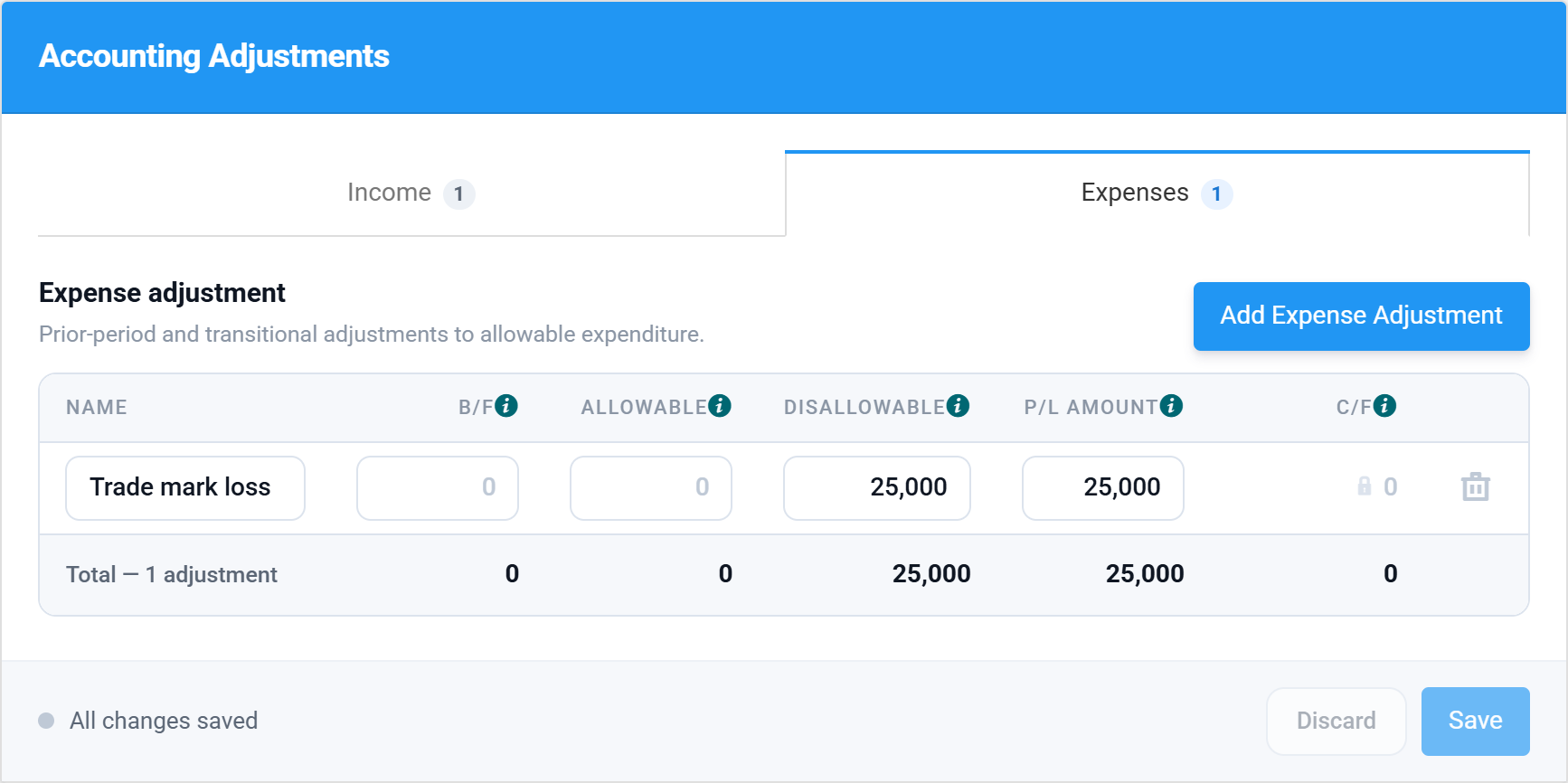
- add back a loss with an Expense adjustment — enter it as both Disallowable and P/L Amount;
- take out a gain with an Income adjustment — enter it as both Non-Taxable and P/L Amount.
Step 2: enter the amounts
Open Corp Tax Calculations and choose Intangibles & Other Reliefs from the Sections menu.
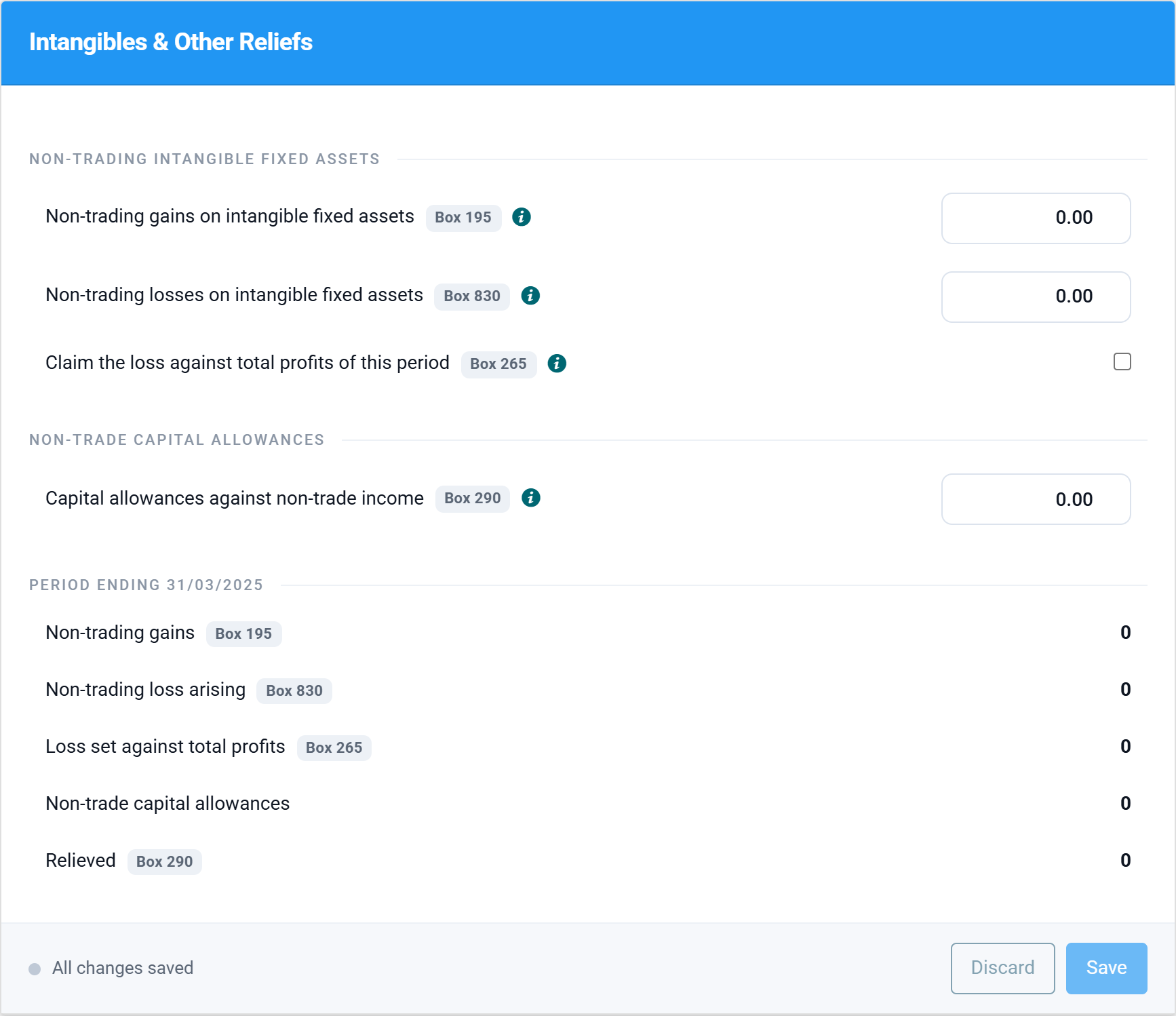
Box 195 — Non-trading gains on intangible fixed assets
Enter a net non-trading credit for the period in Non-trading gains on intangible fixed assets. It is added to total profits alongside the company’s other income.
Box 830 — Non-trading losses arising
Enter a net non-trading debit in Non-trading losses on intangible fixed assets. The whole loss is reported in box 830, whether or not any of it is relieved this period.
Box 265 — Claiming the loss against total profits
A company can claim to set a non-trading loss against its total profits of the same period (s753). Tick Claim the loss against total profits of this period to make the claim; the amount relieved goes in box 265.
The relief ranks after management expenses, property losses and non-trading loan relationship deficits (boxes 240 to 263) and before trading losses (boxes 275 and 285), and it is capped at the profits left. Any loss not relieved — because there is no claim, or not enough profit — is treated as a non-trading debit of the next accounting period (s753(3)). The section and the computation’s Carried Forward Amounts show it; next year, add it to that period’s figure in Non-trading losses on intangible fixed assets (or net it off a gain). It is an intangibles debit, not a loan relationship deficit, so it does not go on the Non Trade Debit section.
Box 290 — Non-trade capital allowances
Capital allowances are normally given in a trade, a property business, or as management expenses of an investment business (box 255). A few are given against other income — most often special leasing: plant or machinery leased out otherwise than in the course of a trade (CAA 2001 s260). Work out the allowance on the pool and enter it in Capital allowances against non-trade income. It is relieved after box 265, capped at the profits left.
The leasing income itself goes in box 205: take it out of the trade with an Income adjustment and enter it on the Other Income section. Property business allowances belong on the Assets section, not here.
A worked example
Example Brand Consultants Ltd, a marketing consultancy, has a profit per accounts of £130,000 for the year ended 31 March 2025. In the year it:
- sold a portfolio of trade marks and domain names it had held as an investment, at a loss of £25,000 — a non-trading debit;
- leased a standby generator to an unconnected business outside its trade, for £15,000 of rent, with £6,000 of capital allowances on it.
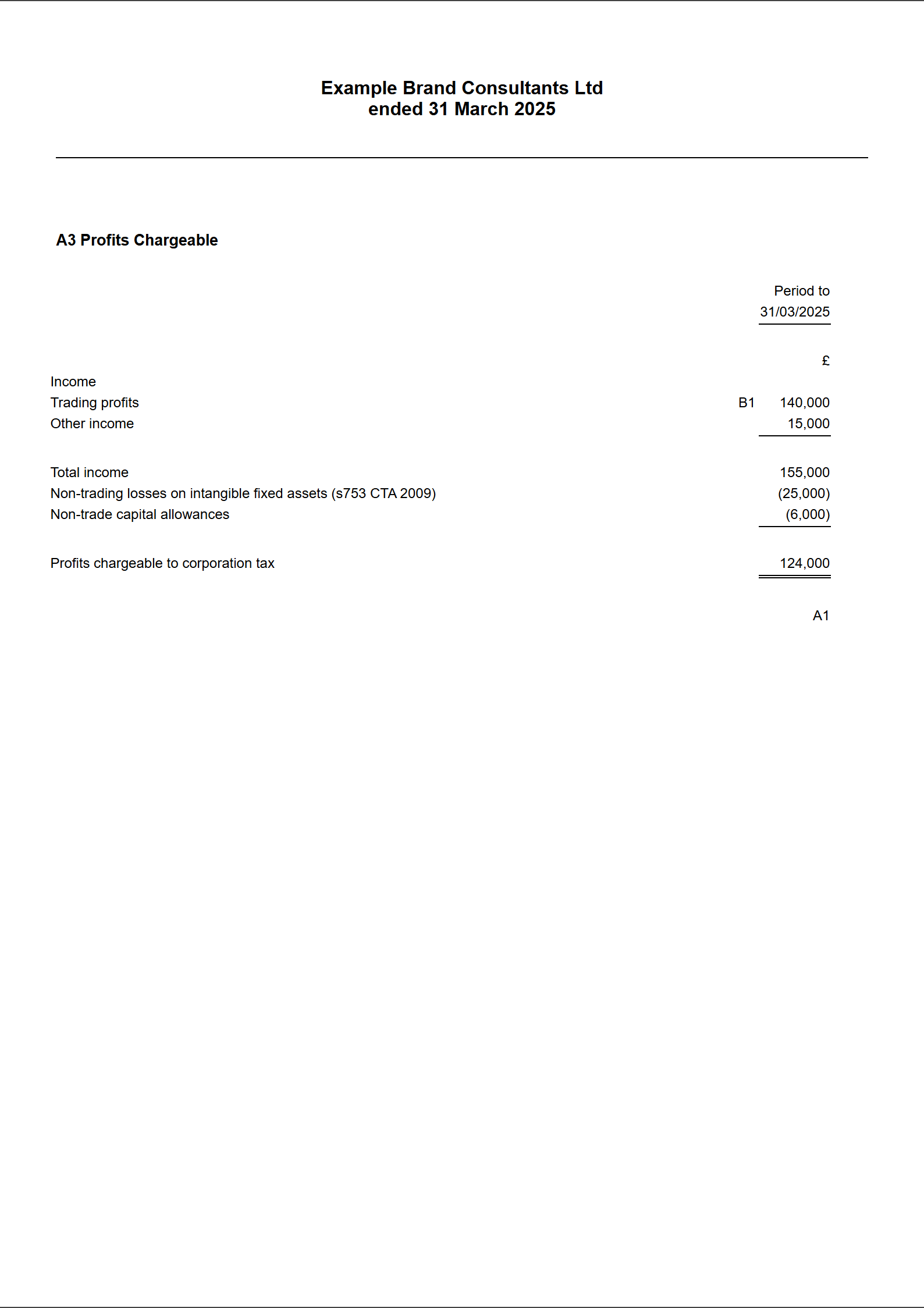
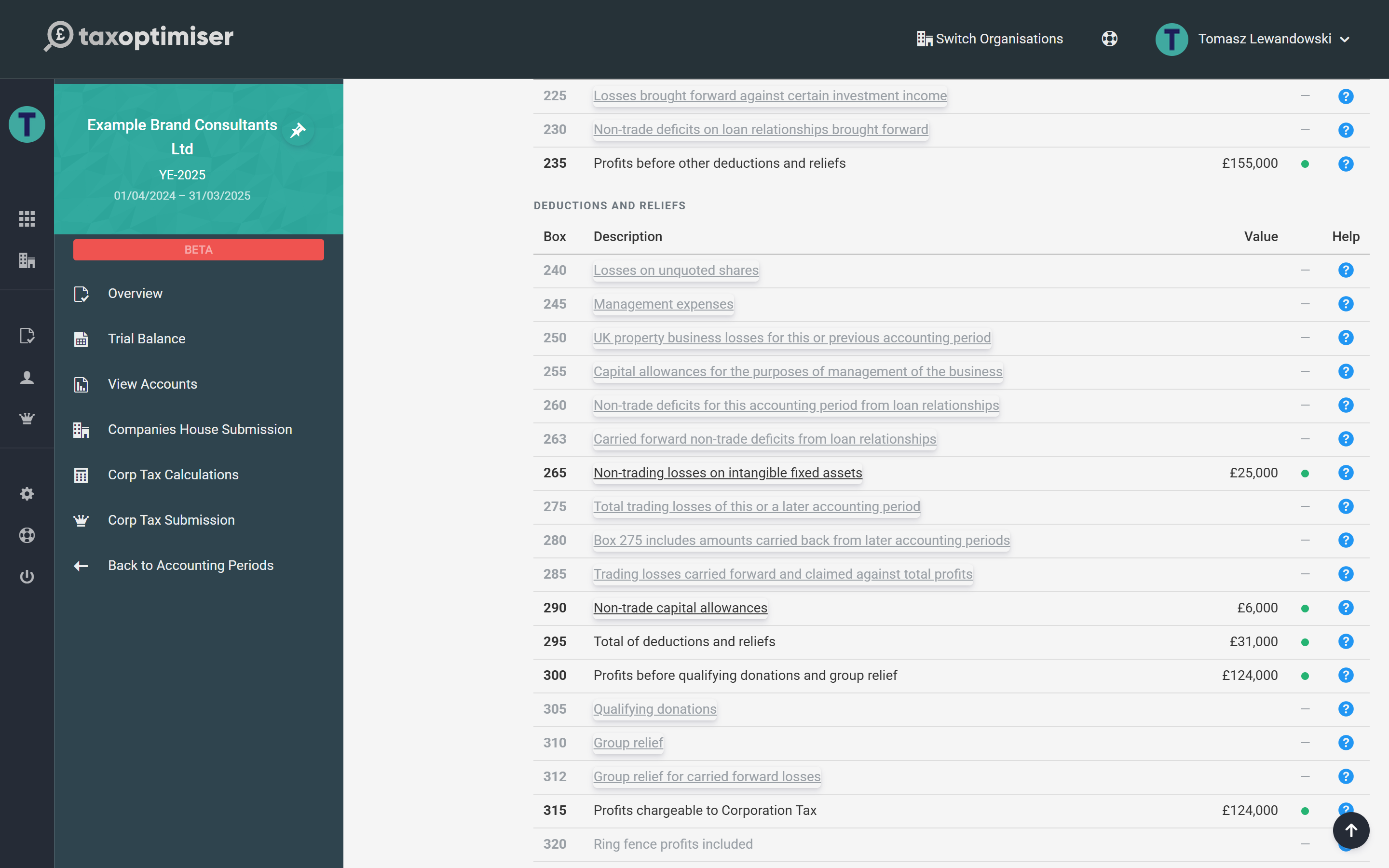
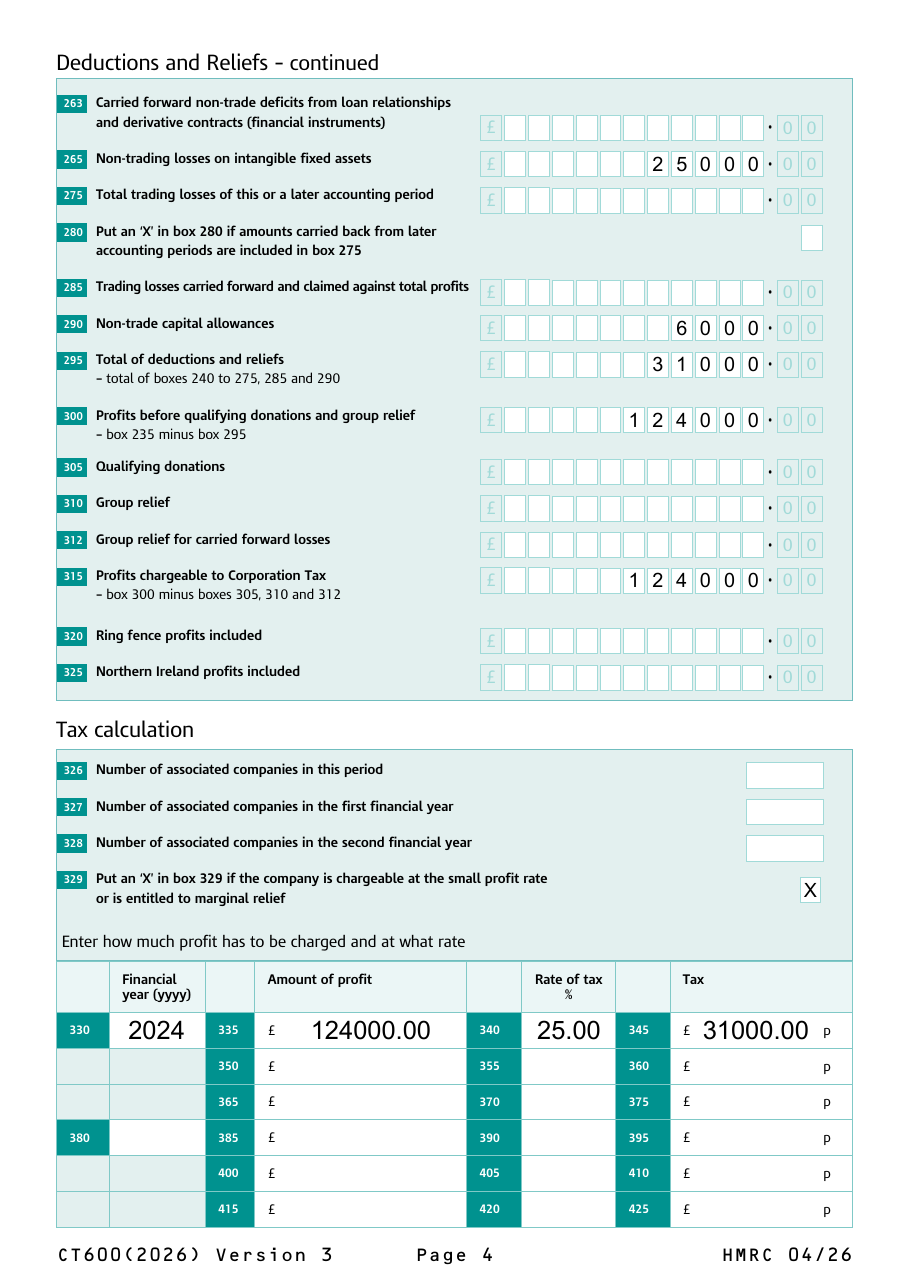
The Expense adjustment adds back the £25,000 and the Income adjustment takes out the £15,000, so the trading profit is £140,000. With the rent in box 205, box 235 is £155,000. The loss is claimed (box 265, £25,000) and the allowances relieved (box 290, £6,000), leaving £124,000 chargeable. Tax at 25% less marginal relief: Corp Tax Payable £29,110.
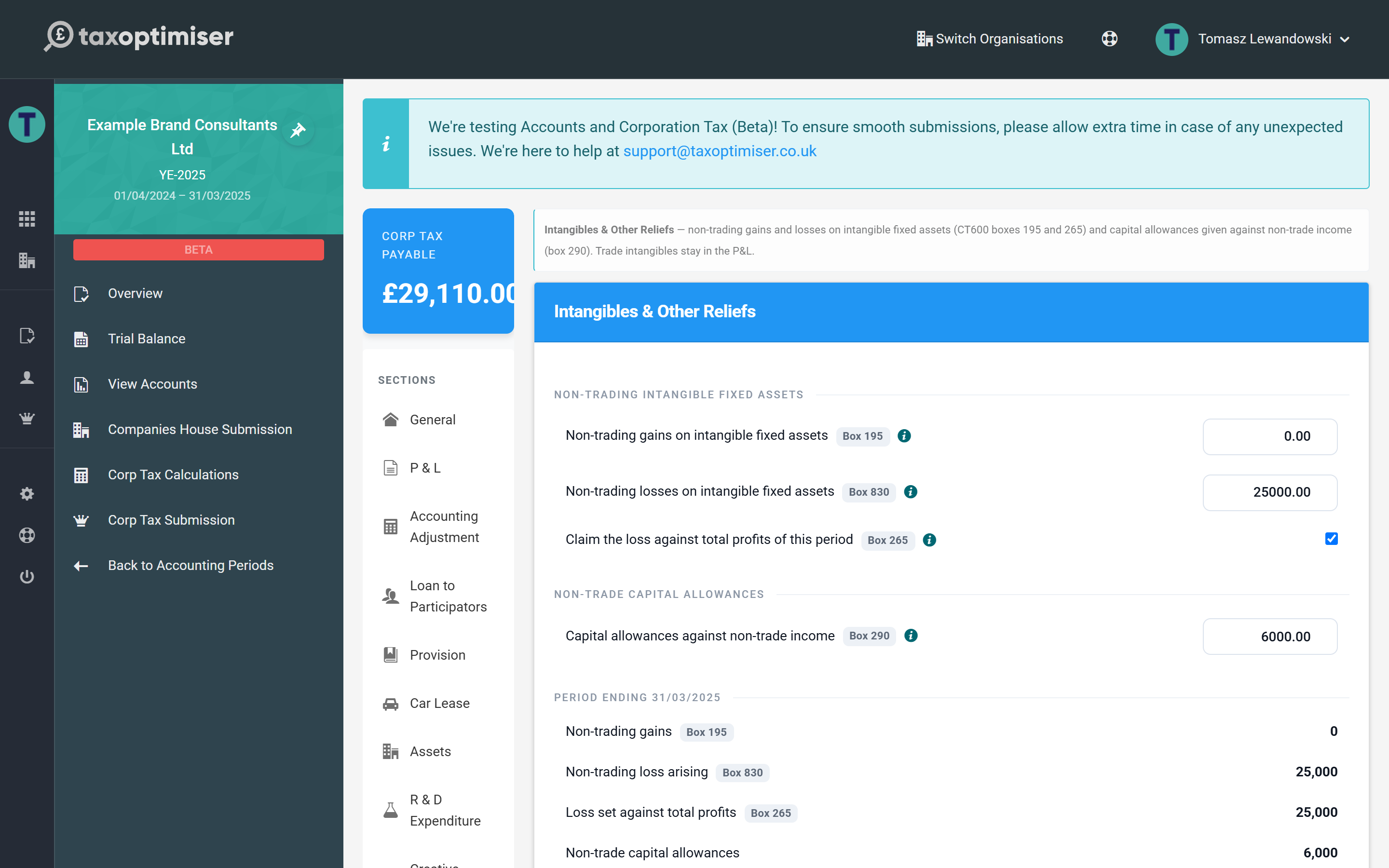
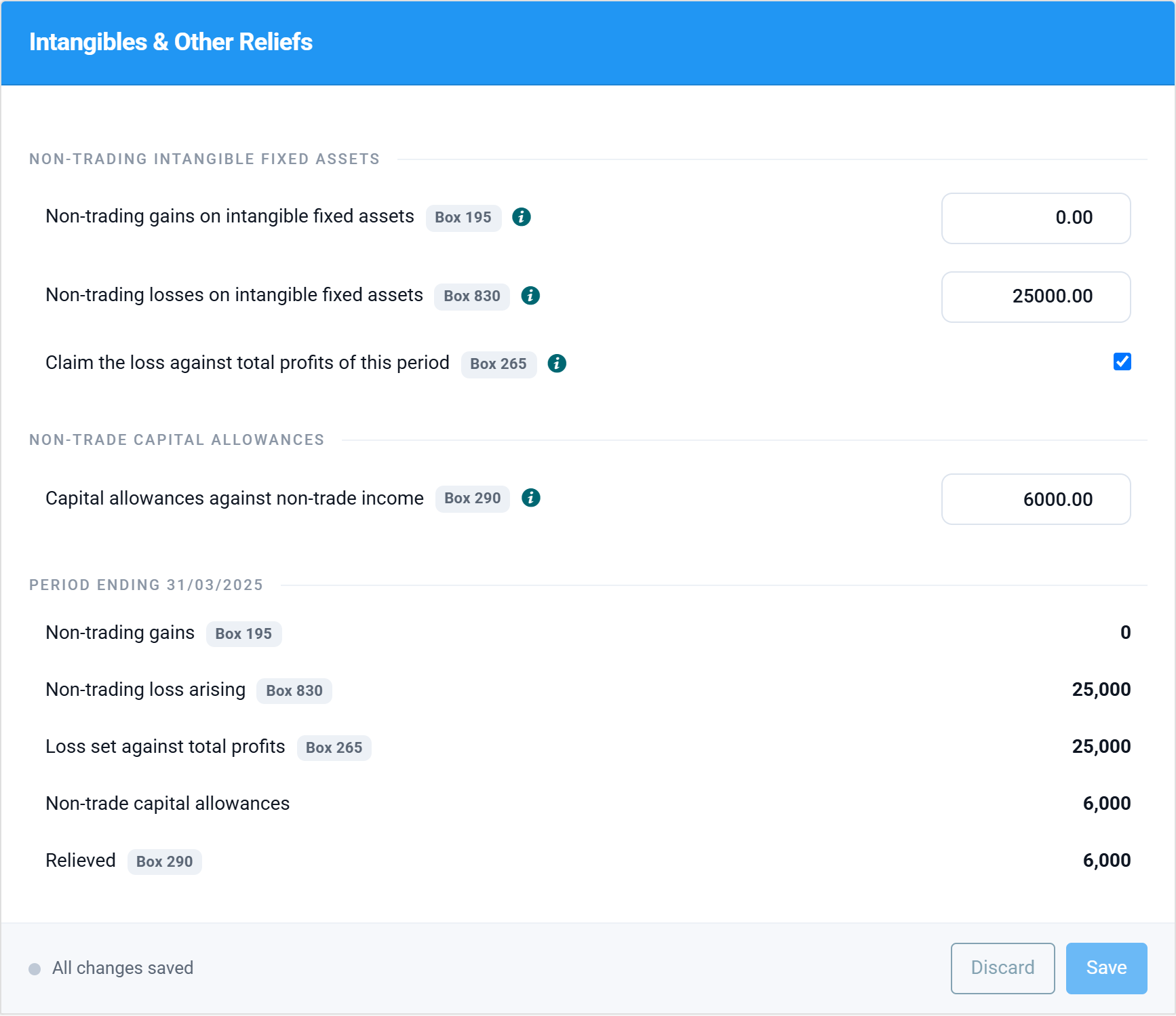
The computation lists both reliefs after total income, and the CT600 carries them on page 4.
Long periods and charities
For a period of account longer than twelve months, the figures are entered once and shared between the two returns by days; each return claims its own share. A charity or CASC claiming exemption on all its income has none of these amounts charged or relieved.
Frequently asked questions
What is a non-trading loss on intangible fixed assets?
A net debit on intangible assets such as trade marks, goodwill or IP that the company holds for a purpose other than its trade, for example as an investment. It is reported in box 830 and can be claimed against total profits in box 265.
Do I have to claim the loss against this period’s profits?
No. Without a claim the loss is treated as a non-trading debit of the next period. Tick Claim the loss against total profits of this period to use it now.
What happens to the part of the loss that is not relieved?
It carries forward as a non-trading debit of the next accounting period. The computation shows it under Carried Forward Amounts; next year, add it to that period’s non-trading intangibles figure on the Intangibles & Other Reliefs section.
Are intangible assets chargeable gains?
Not for assets created or acquired from 1 April 2002: they are taxed under the intangible fixed assets regime instead, in the trade or in boxes 195 and 265.
What goes in box 290?
Capital allowances given against income other than a trade, property business or management expenses, most often on plant leased out otherwise than in the course of a trade (special leasing).
Where to go next
- Other income on the CT600 — boxes 175, 180 and 185.
- Chargeable gains on the CT600 — disposals of other capital assets.
- CT600 box-by-box guide — every box on the main return.